
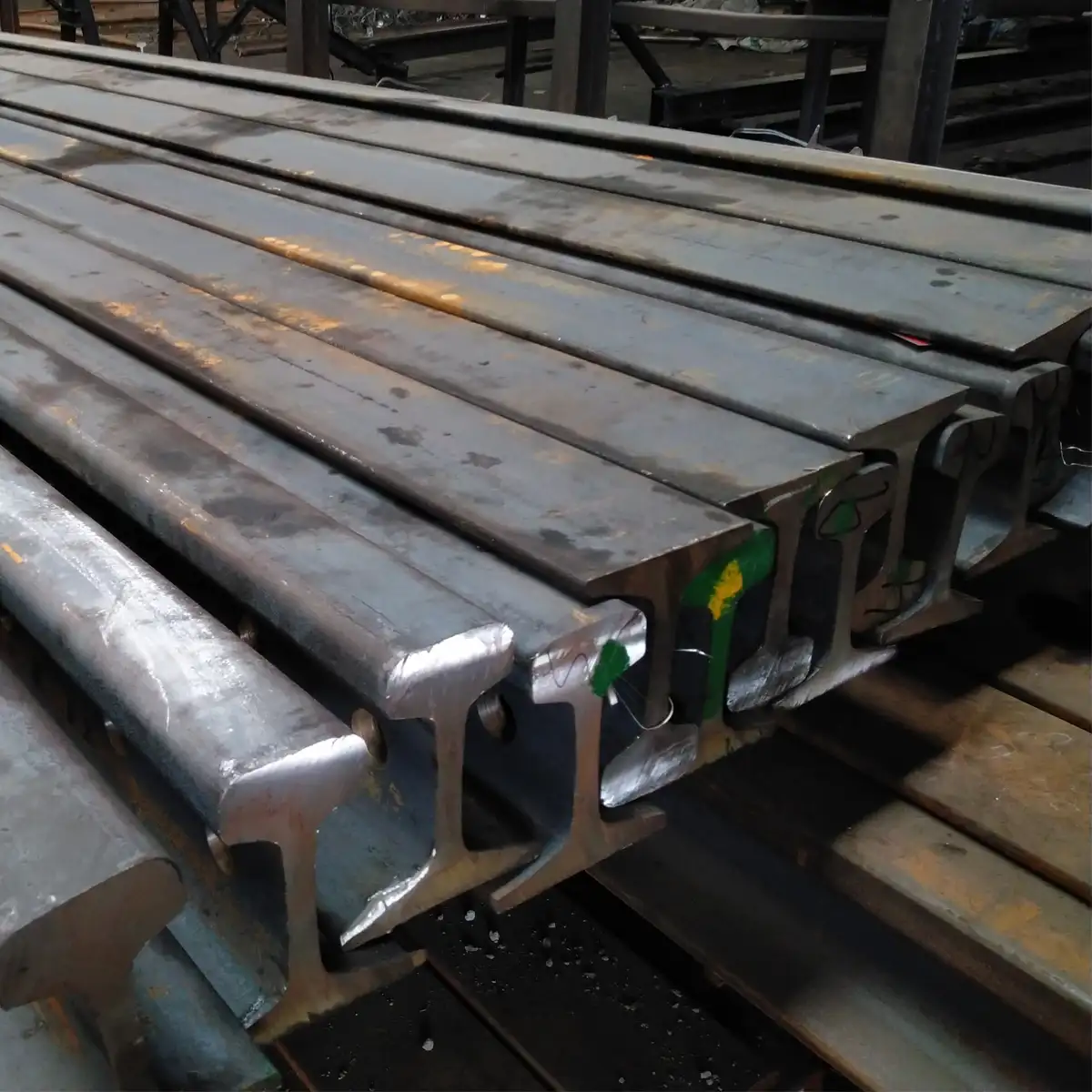
ASCE 80 Rail
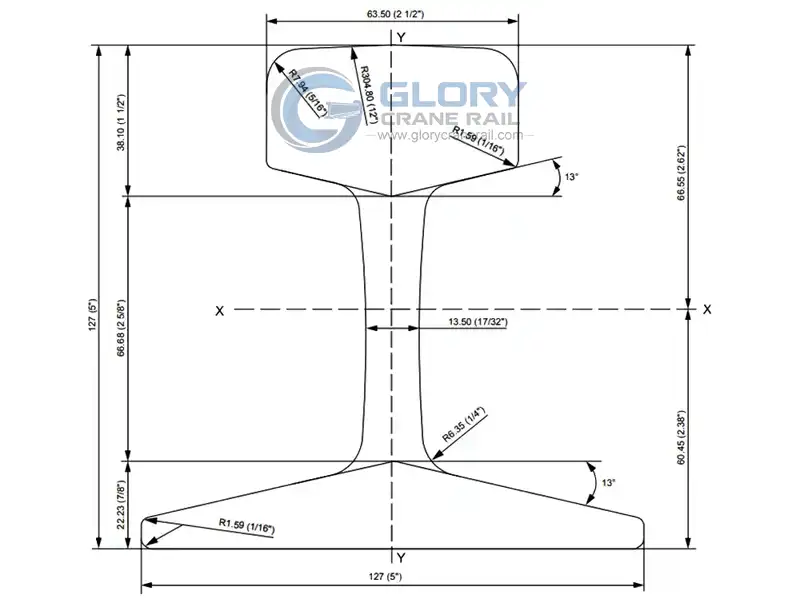
ASCE 80 rail is a flat-bottomed T-section rail in the ASCE series and falls within the scope of ASTM A1 for carbon steel T-rails weighing 60 lb/yd or more. It is used for crane and industrial tracks rated at 39.68 kg/m.
In crane runway applications, the selection of rails should not be based solely on nominal weight; it must also take into account the contact relationship between the rail head and the crane wheels, the support beam structure, the fastening method, and the installation geometry.
Glory Rail supplies ASCE 80 rails and can conduct preliminary engineering evaluations of wheel-rail contact, rail support conditions, and fixed joints based on project drawings and technical requirements, while coordinating the supply of rails and related system components.
Quick System Match: Find the Right ASCE 80 Rail Solution
Select your project requirements below, and our engineering team will provide a customized rail, clip, and pad configuration within 12 hours.
ASCE 80 Rail Basic Dimension
Before finalizing the rail selection, verify the key ASCE 80 rail dimensions. The table below lists the basic parameters for common 80 lb ASCE rail cross-sections. Before placing an official purchase order, verify the specific rail type using the approved cross-section drawings.
| Rail Profile | Standard | Dimensions | Mass | |||
|---|---|---|---|---|---|---|
| Head Width | Height | Base Width | Web Thickness | |||
| ASCE 80 Rail | ASTM A1/ AREMA | 63.5mm | 127mm | 127mm | 13.89mm | 39.68 kg/m |
ASCE 80 Rail Quantity Calculator
Enter the total weight required, select the finished rail length, and instantly get the number of 12-meter raw rails needed, the number of finished rails, the total purchase weight, and the amount of scrap material.
Enter a total weight to calculate.
How we calculate
Required length = total weight ÷ 39.68 kg/m. Finished pieces = required length ÷ chosen length, rounded up. 12 m bars = finished pieces ÷ pieces per 12 m bar, rounded up. Offcut = purchased length − finished length. Saw kerf and mill tolerance are not included.
Cut yield = finished length ÷ purchased length. Above request = purchased weight − entered weight.
Mechanical properties of 80 LB ASCE Rail
| Materials | Tensile Strength (MPa) | Yield Strength (MPa) | Elongation | Hardness (HB) |
|---|---|---|---|---|
| U71Mn | ≥ 880 MPa | ≥ 390 MPa | ≥ 9% | --- |
ASCE 80 Rail Chemical Composition
| Materials | Chemical Composition (%) | |||||||
|---|---|---|---|---|---|---|---|---|
| C | Si | Mn | S | P | Cr | Ni | Cu | |
| U71Mn | 0.65-0.76 | 0.15-0.35 | 1.10-1.40 | ≤ 0.030 | ≤ 0.030 | ≤ 0.250 | ≤ 0.250 | ≤ 0.250 |
ASCE 80 Rail Applications
ASCE 80 rail is a T-shaped rail with a nominal weight of 80 lb/yd, suitable for applications where the rail head geometry, wheel loads, and support arrangement meet operational requirements. Key applications for evaluation include light-duty crane running tracks, underground mine and tunnel tracks, automated warehouse retrieval systems, and industrial transfer tracks.
Specific applicability depends on the actual wheel pressure, wheel size, operating speed, operating frequency, and rail support conditions. The following sections outline the selection criteria for ASCE 80 and the technical conditions that must be verified for different application scenarios.
Light-Duty Overhead Crane Runways
For certain light-duty overhead crane runways in manufacturing shops, equipment maintenance areas, and internal production areas, ASCE 80 may be considered if the calculated wheel load and operating conditions fall within the verified load-carrying capacity of that cross-section.
Typical selection criteria include:
- Maximum wheel load when the crane is in its most unfavorable position.
- Matching of the 63.5 mm rail head width with the wheel tread and flange geometry.
- Running girder stiffness and rail support conditions
ASCE 80 should be evaluated in conjunction with the crane’s actual duty class and wheel arrangement. A higher crane capacity does not necessarily mean that this rail is suitable.
Underground Mining & Tunnel Transport Tracks
The 80-lb ASCE rail also belongs to the light-duty rail series for industrial tracks. Therefore, for underground transport routes with a fixed gauge, its suitability for use in mine cars, material transfer vehicles, and underground service equipment can be evaluated based on actual axle loads and track structure.
Key Selection Factors:
- Axle load and single-wheel contact pressure under full load conditions.
- Gauge, curve radius, and track gradient.
- Support method, humid environments, and maintenance conditions.
For mine haulage routes using heavy-duty locomotives or those with high axle loads, ASCE 80 should not be selected based solely on rail weight. Structural and wheel-rail contact evaluations must be conducted before formally determining the model.
Automated Warehouse Retrieval Systems
For certain rail-guided warehouse vehicles and retrieval systems, the applicability of ASCE 80 may be evaluated if the cross-section of the rail track and the structural load-bearing capacity meet the equipment requirements.
Key selection factors:
- Wheel diameter, tread width, and wheel load distribution.
- Rail straightness, elevation, and joint transitions.
- Equipment operating frequency and support stiffness.
ASCE 80 T-section structures are suitable as candidate rails only when their cross-sections and load-bearing capacity meet the requirements of the warehouse equipment manufacturer. For precision systems requiring stricter geometric tolerances or special guide contact surfaces, other rails or specialized guide cross-sections may be necessary.
Industrial Transfer & Material Handling Tracks
For certain industrial transfer vehicles that operate along fixed tracks, the applicability of ASCE 80 can be assessed when the wheel load and operating conditions are clearly defined.
Key Selection Factors:
- Calculate the wheel load based on the vehicle’s dead weight and payload.
- Frequency of equipment startup, braking, and operation.
- Rail support capacity and joint alignment.
Glory Rail can coordinate ASCE 80 cross-sections with the support and fastening methods required for the project based on vehicle and track drawings.
Engineering Note: The suitability of a rail must be verified based on the project’s actual loads, support conditions, and relevant design requirements; it cannot be determined solely by the rail model.
Not sure if ASCE 80 rail is suitable for your equipment?
Please provide the equipment type, wheel load information, operating conditions, and support layout.
Glory Rail can assist with a preliminary review of track specifications and system compatibility, and identify technical
points requiring further verification—this technical review service is provided free of
charge by Glory Rail’s Engineering Department.
ASCE Rail – Custom Processing Services
Glory Rail offers project-specific ASCE 80 rail fabrication services to help customers align rail supply specifications with approved drawings and on-site installation requirements. Depending on the specific rail type and fabrication feasibility, we provide services such as cut-to-length cutting, drilling, end machining, and surface treatment.

Precision Length Cutting
For custom-length ASCE 80 rails, customers may specify the length of each rail, the quantity, the end profiles, the hole locations, and the dimensional tolerance requirements. Our technical team will verify these specifications prior to machining to ensure that the machining requirements are clear and consistent with the project drawings.

Miter Cutting / Beveling
Supports 45° / 60° bevel cuts at the ends of rails (for expansion joints or smooth joints), as well as beveling for welding (beveled ends for thermite/flash butt welding).

Custom Drilling & Punching
The standard ASCE 80 rail drilling pattern is 2-1/2 × 5 in (63.5 × 127 mm) [S1, S3], meaning the ASCE 80 rail hole spacing is 63.5 × 127 mm. Hole diameter follows the fishplate: The Harmer catalog specifies 1 in (25.4 mm), while some steel mill specifications list 7/8 in (22.2 mm) [S1, S3]. Please provide fishplate drawings, and we will drill holes according to the drawings.

Rail Bending & Curving
Glory Rail provide horizontal and vertical cold-bending and arc-forming services for curves in industrial facilities, amusement park rides, and mining tracks.
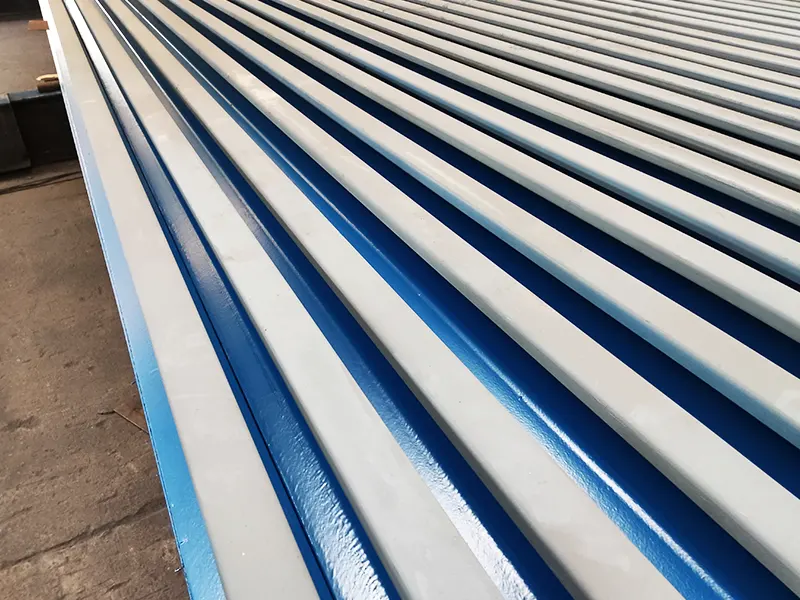
Surface Coating & Treatment
Paint coating, sandblasting for rust removal, application of rust-preventive oil, or hot-dip galvanizing extend the service life in harsh environments.

Chamfering & Deburring
The rail ends are chamfered (2–5 mm × 45°) to prevent damage to the wheel flange during wheel transition. All drilled holes and cut edges are thoroughly deburred to ensure safe handling and installation.
Need a Non-Standard Length or Custom Machining?
Tell us your required rail lengths, quantities, hole patterns, rail-end configurations, and dimensional tolerances.
Glory Rail can review the processing requirements against your project drawings and manufacturing feasibility.
Complete Rail Fastening System & Accessories Supplying
Glory Rail offers a complete range of ASCE crane rails (ASCE20-ASCE85), along with rail fastening systems and custom fabrication services. We provide one-stop supply solutions for crane projects in ports, steel mills, shipyards, warehousing and logistics, and heavy industry.
Glory Rail offers both individual rubber pads and continuous rubber pads, suitable for a wide range of crane rail systems. These rubber pads absorb vibrations, cushion impact loads, and evenly distribute wheel pressure, thereby extending the service life of the rails, foundation structures, and fasteners.


Rail clamps securely fasten the rails while allowing for appropriate movement due to temperature changes and operational loads. We offer welded, bolted, adjustable, and heavy-duty rail clamps suitable for various crane rail models.

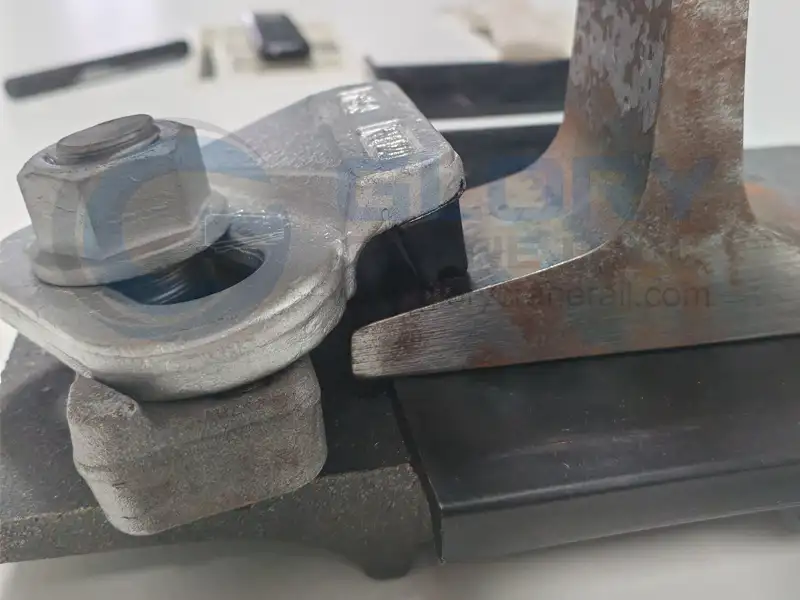
Steel Sole Plates & Base Plates
Glory Rail offers two types of steel pads and base plates.
Long-type base plates: Provide continuous support and improve wheel load distribution.
Short-type base plate: Suitable for stable positioning in compact support structures.


Anchor Bolts & Rail Fasteners
Glory Rail offers anchor bolts, rail bolts, nuts, washers, and a variety of custom rail fasteners. These products provide a reliable connection between the rails, the fastening system, and the concrete foundation, ensuring long-term safe operation.


Rail Fishplates
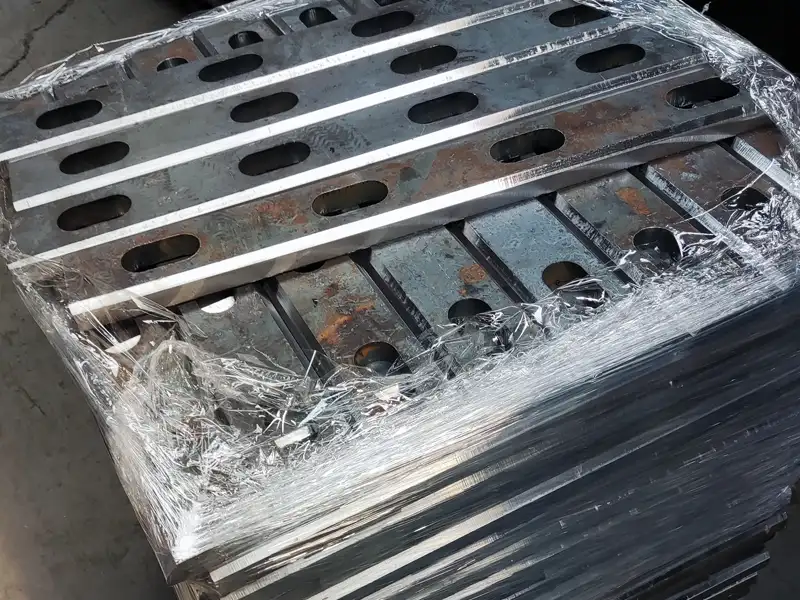
Fishplates(Joint bars) are used to connect rail joints and maintain track continuity and alignment accuracy. We offer both standard and custom-machined products to meet various track standards and project requirements.

Crane Buffers & End Stops
Crane buffers and end stops are designed to absorb impact energy and protect cranes, rails, building structures, and equipment from damage caused by accidental collisions. They are widely used in bridge cranes, gantry cranes, port machinery, and automated material handling systems.


Avoid mismatch risks. Every ASCE 80 rail system requires precisely matched clips, pads,
and baseplates to ensure load distribution and extend service life.
FAQ
ASCE 80 is a U.S. standard T-shaped rail cross-section with a nominal weight of 80 lb/yd, approximately 39.68 kg/m. It is classified as a medium-section rail: it has a compact profile and is suitable for tracks with limited clearance. In some product catalogs, it is also referred to as 80 AS or Section No. 8040.
The tread width, flange geometry, wheel diameter, and effective contact area of the wheel must be verified against the rail head profile. Additionally, the maximum wheel load, operating conditions, and the specified wheel and rail materials should be taken into account.
Glory Rail can supply ASCE 80 rails and coordinate related components—such as rail fasteners, base plates, and steel base plates—in accordance with the confirmed interface requirements. The final configuration must be verified against the project drawings and actual operating conditions.
The method of rail support depends on the wheel load, the stiffness of the running girder, the structural configuration, the support conditions, and the operating cycle. Both continuous and intermittent support systems should be evaluated in conjunction with the actual structural design; they should not be selected based solely on the weight of the rails.
The nominal rail head width specified in ASCE 80 is 63.5 mm (2.5 in). For large STS gantry cranes, high-speed rail-mounted gantry (RMG) cranes, and heavy-duty foundry cranes, a wider running contact surface and higher structural load-carrying capacity may be required.
PEMA recommends a practical running surface width of 100 mm or more for large STS and high-speed, wide-span RMG crane applications. Therefore, unless engineering verification has been conducted for a specific project, ASCE 80 is not recommended as the standard first choice for these types of equipment.
CLIENTS we've worked with


Get In Touch
After submitting the form, your dedicated account manager will contact you immediately to provide full-process technical support from selection to installation.
Your Expert in Crane Rail Solutions
To help us provide a faster and more accurate tailored solution, please consider including:
1. Rail Specifications: Rail section type, profile, or standard, and your required unit length.
2. Order Quantity: Total quantity of rails, matching fasteners, or related equipment needed.
3. Material & Grade: Specific steel material requirements or performance grades.
4. Technical Files: Any custom technical requirements, drawings (CAD/PDF), or project specifications.
Don't have all the details? No worries! Just leave us a message with what you know, and our experts will guide you through the process.