
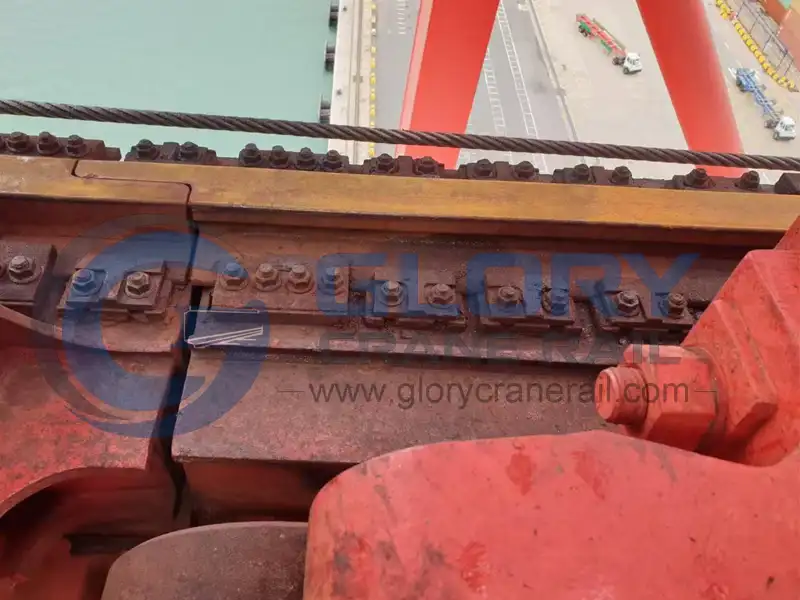
Where and When Do Crane Rails Need Corrosion Protection?
Crane rails used in ports, shipyards, steel mills, mines, and outdoor material handling systems may be exposed to corrosive environments—such as high humidity, rainfall, salt-laden air, and chemical agents—for extended periods. Therefore, an appropriate crane rail corrosion protection solution must be determined based on the operating environment, rail specifications, surface condition, and expected service life.
Glory Rail can provide crane rails with corrosion protection according to project requirements, as well as surface treatment, protective coatings, and custom processing services such as cutting and drilling.
01 Where Is Crane Rail Corrosion Protection Required?
Not all crane rails are exposed to the same corrosive environments. Crane rails in indoor facilities are typically subject to relatively limited atmospheric exposure, whereas those installed in seaports may be continuously exposed to high humidity, rain, and chloride-containing seawater.
According to ISO 12944-2, environmental corrosivity is a key factor to consider when selecting a protective coating system. This standard classifies atmospheric environments based on environmental corrosivity and notes that certain specific corrosive factors may require a higher level of protection.
For crane rail corrosion protection applications, the following environments warrant particular attention:
- Ports and container terminals
- Shipyards and marine facilities
- Outdoor gantry crane systems
- Steel mills and metal processing plants
- Mining and bulk material handling facilities
- Coastal industrial plants
- Cement and construction material plants
- Long-term crane rail storage areas
Therefore, the corrosion protection for crane rails should not simply rely on a single, fixed coating, but should be selected based on the specific project environment.
02. Crane Rail Corrosion Protection in Coastal & Marine Environments
Coastal and marine environments are among those that place high demands on the corrosion protection of outdoor steel structures. Chloride-containing air, moisture, and persistent damp conditions can all increase the corrosion stress on carbon steel structures.
ISO 12944-9 specifically addresses protective coating systems for marine atmospheres and related marine environments, including the CX corrosion environments defined in ISO 12944-2. It should be noted that this standard is not specifically designed for crane rails; however, its environmental classifications and principles for selecting coating systems can serve as a reference when developing project corrosion protection plans.
Representative equipment: Ship-to-Shore (STS) container cranes, Rail-Mounted Gantry (RMG) cranes, large shipyard gantry cranes, and bulk cargo terminal ship loader rails.
For crane rails in marine environments, corrosion protection typically requires consideration of the exposed surface of the rail, while also protecting or excluding the following functional areas:
- Rail head running surface
- Wheel contact areas
- Welded areas
- Machined surfaces
- Drilled holes and custom rail ends
Key Protection Areas and Recommended Solutions:
Heavy-duty anti-corrosion coating system for rail web and rail foot: Epoxy zinc-rich primer (60–80 μm) + glass flake epoxy intermediate coat (125–200 μm) + aliphatic polyurethane topcoat (60–80 μm), with a total dry film thickness (DFT) of ≥320 μm and a design life of 15 years or more.
Rail Top Working Surface: Temporary protection is provided using specialized anti-corrosion grease or a peelable coating, which is removed through natural wear after installation.
Fastening System: Hot-dip galvanizing (HDG, zinc coating thickness ≥85 μm) or Dacromet treatment; bolts are treated using a multi-element diffusion process.
Project Reference: The A65 crane rail project at the Port of Colombo, Sri Lanka. To address the high salt fog environment, strict SA2.5-grade sandblasting for rust removal and high-precision coating thickness control were implemented to ensure compliance with corrosion protection standards.
03. Crane Rail Corrosion Protection for Ports & Container Terminals
Ports and container terminals are key application areas for corrosion-protected crane rails. Port crane rails are typically exposed to outdoor environments and may be subject to prolonged exposure to marine humidity, salty air, and rainfall.
Typical applications include:
- STS (Ship-to-Shore) gantry crane rail systems
- RMG (Rail-Mounted Gantry) container crane rail systems
- Gantry crane rail systems
- Yard material handling equipment
- Heavy-duty harbor crane rail systems
For these projects, customers may procure both crane rail supply and anti-corrosion treatment services.
In our A65 Port crane rail project in Sri Lanka, the customer required a multi-layer protective coating system. Publicly available project data indicates that the project involved an Sa 2.5 surface preparation, followed by two coats of 100 μm two-component zinc-rich epoxy primer and one coat of 60 μm topcoat, resulting in a minimum total dry film thickness of 260 μm. Additionally, the rail heads and welded areas were required to remain uncoated.
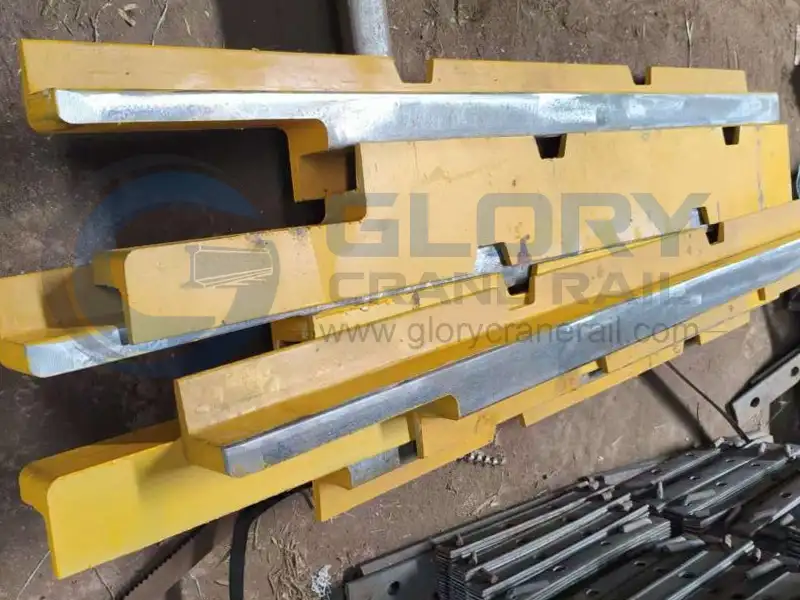

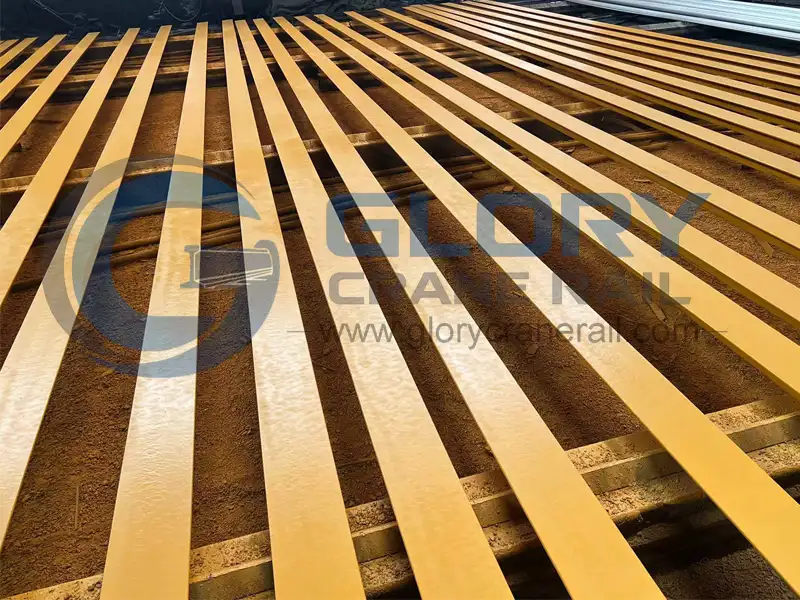
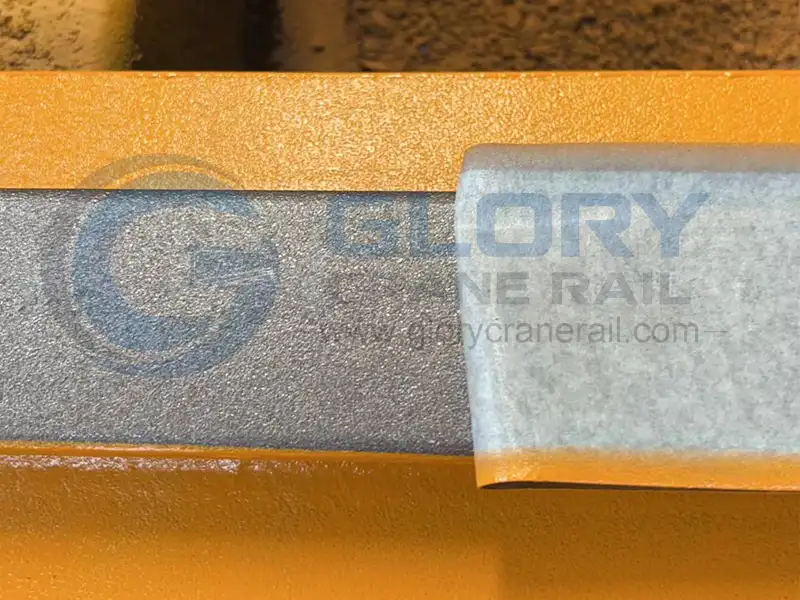
It should be emphasized that the parameters mentioned above—such as 260 μm and Sa 2.5—are specific technical requirements for this project and do not constitute uniform requirements for all crane rail projects.
04. Crane Rail Corrosion Protection for Shipyards
Shipyards and ship repair facilities typically involve both heavy-duty lifting operations and exposure to the marine atmosphere. Therefore, corrosion protection for shipyard crane rails is a key consideration for gantry cranes and other heavy-duty lifting equipment operating outdoors.
Typical applications include:
- Shipyard gantry cranes
- Heavy-duty gantry crane rails
- Transshipment crane systems
- Offshore engineering manufacturing facilities
- Dry dock material handling systems
When developing a corrosion protection plan for shipyard crane rails, consideration should extend beyond the rails themselves to include the connection areas between the rails, fasteners, support structures, and joints.
For example, custom machining processes such as slot cutting and drilling create new exposed surfaces on the steel. Depending on the specific project requirements, these areas may need to undergo further protective treatment.
05. Crane Rail Corrosion Protection in Steel Mills & Heavy Industry
Steel mills, foundries, and heavy manufacturing facilities typically rely on cranes to handle steel, billets, equipment, and other heavy materials. Depending on the plant layout, crane rails may be installed indoors, in semi-outdoor settings, or in fully exposed outdoor environments.
Representative equipment: overhead cranes in acid and alkali production workshops, lifting equipment in fertilizer warehouses, explosion-proof cranes in liquid chlorine/ammonia workshops, and maintenance cranes in refinery tower areas.
Potential corrosion factors include: moisture and water; industrial dust; pollutants generated during production processes; high-temperature areas; and exposure to outdoor weather conditions.
Therefore, corrosion protection solutions should be determined based on the actual operating environment.
There is a very important technical distinction here:
Corrosion resistance and wear resistance are not the same performance requirements.
Coatings designed for protection against atmospheric corrosion should not automatically be assumed to withstand the long-term contact and wear between crane wheels and rails.
Therefore, in heavy-industry crane rail projects, it is essential to clearly identify which areas require corrosion protection and which areas must maintain normal operational functionality.
06. Crane Rail Corrosion Protection for Mining & Bulk Material Handling
Rail systems in mines, mineral processing plants, and bulk material handling facilities may be simultaneously exposed to dust, moisture, rain, and outdoor atmospheric conditions.
Typical applications include: mine sites; mineral processing facilities; bulk cargo terminals; coal handling facilities; cement plants; and quarries.
In these environments, crane rail anti-corrosion treatment should be considered in conjunction with the mechanical performance requirements of the rail system itself, based on actual conditions.
When selecting a corrosion protection solution, it is recommended to consider the following:
- Whether the track will be installed indoors or outdoors
- Exposure to moisture and rain
- Chemical agents or production contaminants
- Expected service life
- Future maintenance conditions
- Track fabrication and on-site installation requirements
07. Outdoor Crane Rail Applications That May Require Corrosion Protection
Outdoor installations are one of the typical scenarios where rail corrosion protection requires special attention.
Common outdoor crane rail applications include:
- Outdoor gantry cranes
- Gantry cranes
- Yard cranes
- Transfer cranes
- Outdoor material storage yards
- Semi-open workshops
- Port material handling systems
However, the term “outdoor” alone does not determine which specific corrosion protection system should be used.
For example, even for outdoor crane rails, the corrosion risks may vary significantly depending on whether the project is located inland, in a coastal area, in a high-humidity region, or in an industrial setting where chemical corrosive agents are present.
Therefore, crane rail corrosion protection applications should be evaluated based on actual environmental exposure conditions, rather than judged solely on the basis of “indoor/outdoor.”
08. Which Parts of a Crane Rail Can Be Corrosion Protected?
The crane rail corrosion protection service is not simply a matter of “painting the entire rail.”
Different sections of the crane rail serve different functions, so treatment areas must be distinguished based on project requirements.
Areas that may require corrosion protection include:
- The web and exposed surfaces
- The sides of the rail
- The rail base
- Cut ends
- Drilled areas
- Machined areas
- Other exposed steel surfaces
At the same time, some functional areas may need to remain uncoated.
For example, the available A65 port crane rail project explicitly requires that rail heads and welded areas remain uncoated to meet wheel contact and on-site welding requirements.
Therefore, the crane rail coating specification should clearly specify both:
Where to coat + Where not to coat
rather than simply stipulating that “the entire rail should be coated for corrosion protection.”
09. Crane Rail Corrosion Protection Methods
There is no single crane rail anti-corrosion treatment that is suitable for all projects.
Depending on the specific project requirements, anti-corrosion treatment may include:
1. Surface Preparation
Proper surface preparation is a critical component of a protective coating system. ISO 12944-4 specifies the types of surfaces and surface preparation methods for carbon steel and low-alloy steel.
Depending on requirements, specific projects may employ appropriate surface preparation methods such as sandblasting or shot blasting.
2. Primer + Protective Topcoat
ISO 12944-5 introduces common protective coating systems and provides guidance on selecting coating systems based on the environment and expected durability.
3. Epoxy Zinc-Rich Primer System
For certain projects, a zinc-rich primer system may be used according to customer requirements.
4. Temporary Rust Prevention
For rails that require long-term storage during transportation or prior to installation, temporary rust protection may be applied according to project requirements.
5. Customized Multi-Layer Corrosion Protection Systems
For projects with a high risk of corrosion, customers may specify the number of coats, colors, and total dry film thickness.
Please note: The type of coating, coating thickness, and surface finish grade should be determined based on the specific project; the parameters of a single project should not be directly considered a universal standard for all crane rail projects.
10. Crane Rail Corrosion Protection Is Not a One-Size-Fits-All Solution
The right crane rail corrosion protection solution depends on the specific project conditions.
Before proceeding with corrosion protection treatment, customers can provide the following information:
ISO 12944-2 clearly states that environmental corrosivity is a key parameter in selecting a protective coating system.
Therefore, a professional custom crane rail corrosion protection service should begin by understanding the actual operating environment.
11. Can Crane Rails Be Supplied with Customized Corrosion Protection?
Yes. Glory Rail can provide customized anti-corrosion treatment for crane rails based on specific project requirements.
Customers do not necessarily need to go through the following process:
Crane rail supplier → Third-party processing plant → Anti-corrosion company → Packaging → Export
Instead, the supply, processing, and anti-corrosion treatment of the rails can be coordinated as a single integrated project.
Glory Rail can coordinate the following services according to project requirements:
- Supply of crane rails
- Custom cutting to length
- Drilling of rails
- Custom bevel cuts (e.g., 45°)
- Surface treatment
- Anti-corrosion coating
- Quality inspection
- Protective packaging
- Export shipping
This integrated approach is particularly well-suited for projects with specific requirements regarding rail length, machining dimensions, coating areas, and shipping packaging.
12. Our Crane Rail Corrosion Protection Workflow
A customized crane rail corrosion protection service can be carried out in accordance with the project workflow:
1
Project Requirements Confirmation
Confirm the rail type, dimensions, quantity, application scenario, and corrosive environment.
2
Rail Specification
Confirmation
Confirm DIN, QU, ASCE, JIS, or other required rail specifications.
3
Custom Rail
Fabrication
Perform cut-to-length cutting, drilling, beveling, and other processing as required by the customer.
4
Surface
Treatment
Treat the steel surface according to the specified coating system.
5
Corrosion Protection
Apply a primer and protective coating system in accordance with project requirements.
6
Quality Inspection
Inspect dimensions, surface condition, and coating-related requirements in accordance with project technical specifications.
7
Protective Packaging
Protect the treated rails during handling, storage, and international transport.
8
Export Delivery
Arrange international transport in accordance with the customer’s delivery requirements.
13. Glory Rail—Crane Rail Supply & Corrosion Protection
Glory Rail provides crane rail supply and customized crane rail corrosion protection services for industrial and infrastructure projects.
For customers who need to purchase crane rails and also wish to have surface treatment or corrosion protection applied prior to delivery, we can provide corresponding support services based on project requirements.
We supply commonly used crane rail specifications, including DIN 536 crane rails, QU series crane rails, ASCE series crane rails, JIS series crane rails, and other rail specifications required for specific projects.
If customers require further processing, Glory Rail can coordinate the following:
- Cutting lifting rails to specified lengths
- Drilling holes in rails
- Custom machining of rails
- Surface treatment of lifting rails
- Anti-corrosion coating
- Custom coating and non-coating areas
- Protective packaging for export shipping
Matching Corrosion Protection Requirements to Track Application Environments
Different crane rail projects face varying corrosion environments.
For example, crane rails installed in coastal ports may face significantly different corrosion environments compared to those installed inside steel mills or stored in inland warehouses.
Therefore, when coordinating the anti-corrosion treatment for crane rails, Glory Rail takes into account the following information provided by the customer:
- Rail specifications
- Installation environment
- Indoor or outdoor application
- Coastal or inland location
- Actual environmental exposure conditions
- Anti-corrosion coating requirements
- Rail processing requirements
- Transportation and storage conditions
This approach allows for the supply of crane rails and anti-corrosion requirements to be considered as a single integrated solution, rather than treating them as two completely separate procurement projects.
Crane Rail Corrosion Protection Applications by Industry
| Industry / Application | Typical Environment | Corrosion Consideration |
|---|---|---|
| Ports & Terminals | Marine atmosphere, humidity, salt-laden air | High attention to atmospheric corrosion |
| Shipyards | Marine atmosphere, moisture, outdoor exposure | Customized protection may be required |
| Steel Mills | Industrial atmosphere, dust, moisture | Environment-specific treatment |
| Mining | Dust, moisture, outdoor exposure | Surface protection and maintenance |
| Bulk Material Handling | Outdoor storage and material handling | Weather and moisture exposure |
| Coastal Plants | Humidity, chloride-containing atmosphere | Enhanced corrosion protection may be required |
| Outdoor Gantry Cranes | Rain, humidity, UV exposure | Protective coating may be considered |
| Long-Term Storage | Humidity and condensation | Temporary corrosion protection |
Do you need custom anti-corrosion treatment for crane rails?
Whether you need anti-corrosion crane rails for ports, shipyards, outdoor use, or heavy industrial environments, the anti-corrosion solution should be tailored to the actual operating environment.
Please provide us with the rail model, drawings, quantity, and application environment.
Glory Rail can coordinate the supply, custom fabrication, anti-corrosion treatment, quality inspection, and export packaging of crane rails into a single integrated project.
Get In Touch
After submitting the form, your dedicated account manager will contact you immediately to provide full-process technical support from selection to installation.
Your Expert in Crane Rail Solutions
To help us provide a faster and more accurate tailored solution, please consider including:
1. Rail Specifications: Rail section type, profile, or standard, and your required unit length.
2. Order Quantity: Total quantity of rails, matching fasteners, or related equipment needed.
3. Material & Grade: Specific steel material requirements or performance grades.
4. Technical Files: Any custom technical requirements, drawings (CAD/PDF), or project specifications.
Don’t have all the details? No worries! Just leave us a message with what you know, and our experts will guide you through the process.