
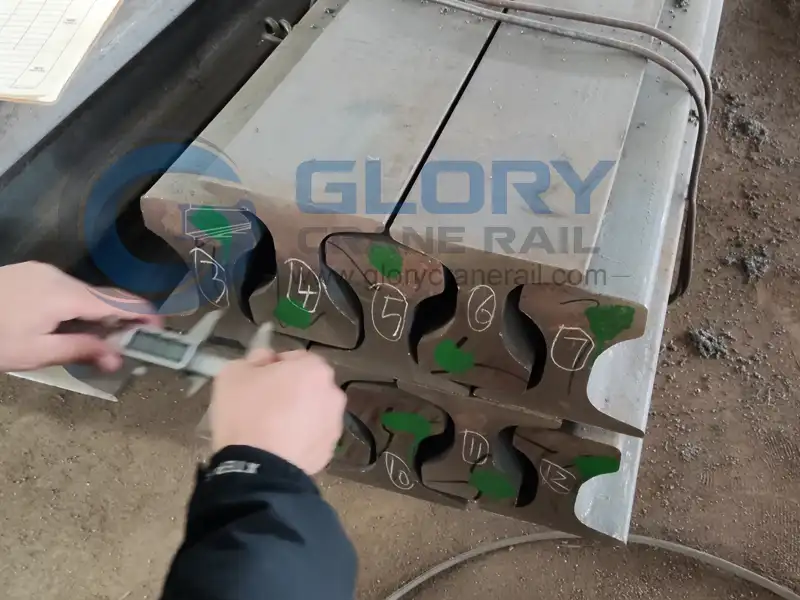
China’s Ministry of Industry and Information Technology has officially released the YB/T 5055-2025 standard [Source: MIIT Announcement No. 20 of 2025]. As a brand-new, updated standard for QU crane rails, this standard fully replaced the previous version (YB/T 5055-2014) on March 1, 2026. This engineering technical guide provides expert answers to key concerns regarding wheel-rail interface design, dimensional calculation rules, and newly added steel grades.
Key Engineering Verdict: Does New Crane Rail Standard Affect Wheel Selection?
Whenever national or industry standards are updated, the question that most concerns structural engineers and procurement managers is often: “Does the new crane rail standard affect wheel selection?”
The straightforward technical conclusion is: there is absolutely no impact. According to the technical requirements in the YB/T 5055-2025 standard [Source: YB/T 5055-2025, Section 5.1], all major cross-sectional parameters of the QU series rails (running surface width, rail height, rail base width, and web thickness) remain consistent with those of the previous edition of the standard. Consequently, all existing standard wheel profiles remain perfectly and fully compatible with QU rail dimensions.
Overview of Crane Rail Types & Applications
Crane rails are typically classified based on load-bearing capacity and operational requirements:
Light & Medium-Duty Cranes (Trolley & Gantry):
- P-Type Light Rails: P15, P18, P24, P30
- Railway Steel Rails: 38kg/m (P38), 43kg/m (P43), 50kg/m (P50), 60kg/m (P60)
Heavy-Duty Cranes & Large Gantry Cranes:
- QU-Type Crane Rails: QU70, QU80, QU100, QU120 (Dedicated crane rail profiles )
YB/T 5055-2014 vs YB/T 5055-2025: Major Technical Updates
Although the dimensions of the core profiles remain unchanged, an in-depth comparison of YB/T 5055-2014 and YB/T 5055-2025 reveals that, as the core Chinese standard for crane rails [Source: National Technical Committee on Steel Standardization (SAC/TC183)], the new standard introduces significant upgrades in terms of quality and material composition:
| Parameter / Parameter | Old Standard / YB/T 5055-2014 | New Standard / YB/T 5055-2025 | Impact & Value |
|---|---|---|---|
| Fixed Length Range | Fixed at 9m–12.5m; Short rails 6m–8.9m | 6m to 12m (Custom length available upon request) | More flexible for ocean shipping & installation |
| Steel Grades | U71Mn, U75V, U77MnCr, U78CrV, U76CrRE | Added U68CuCr, U22SiMn, U20Mn | Broader selection for special operating conditions |
| Delivery Condition | As-Rolled (Hot Rolled) | U22SiMn, U20Mn in Tempered state; others As-Rolled | Better fatigue strength and toughness |
| Reduction Ratio | General ratio requirement | Minimum 7 : 1 compression ratio mandatory | Reduces internal defects & improves structural density |
| Rail Marking | Embossed height: 0.5mm – 1.5mm | Embossed height: 0.3mm – 1.5mm | Improves legibility during quality inspection |
Material Selection: U20Mn vs U71Mn Crane Rail Material
The inclusion of low- and medium-carbon alloy rails in the new standard provides engineers with greater flexibility in customizing material specifications. When evaluating U20Mn versus U71Mn crane rail materials:
U71Mn (high-carbon manganese steel): A traditional high-strength rail material characterized by high surface hardness (HBW ≥ 280) and excellent wear resistance [Data source: YB/T 5055-2025, Table 3]. It remains the standard material of choice for general-purpose heavy-duty bridge and gantry cranes.
U20Mn / U22SiMn (low-carbon alloy steel, supplied in a tempered condition): These new grades are supplied in a tempered condition and offer superior weldability and impact toughness, making them ideal for low-temperature port crane environments and rail systems that require frequent on-site welding.
Engineering Calculation: How to Calculate QU Crane Rail Dimensions
When designing projects, conducting on-site measurements and verifications, or creating quick CAD drawings, engineers often ask, “How do I calculate the dimensions of QU crane rails?” The structural dimensions of the QU series rails strictly adhere to geometric formulas based on the width of the rail head and tread:
Rail Height (H) = Rail Base Width (B) = Tread Width (W)+ 50mm
When calculating the crane rail tread width, the number following the “QU” model designation directly represents the core dimension of the tread:
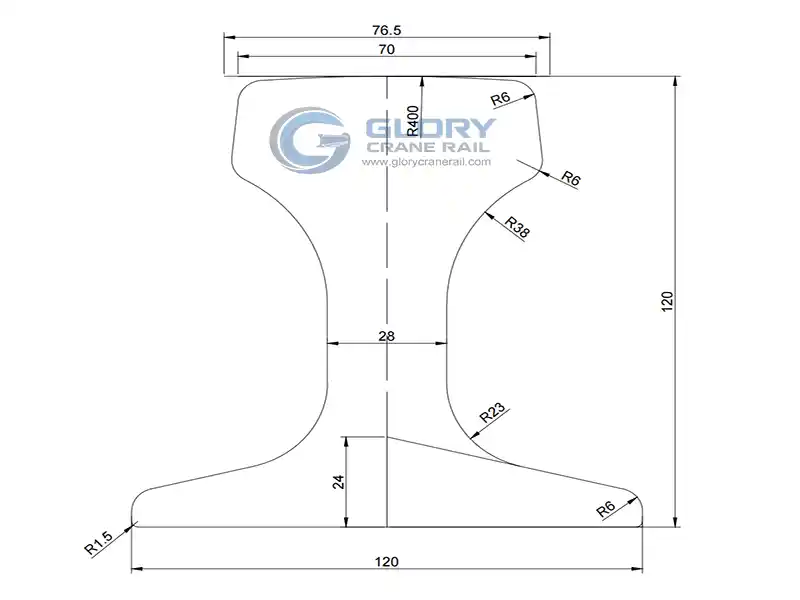
QU70:
Tread Width = 70 mm |
Height & Base Width = 120 mm (70 + 50)
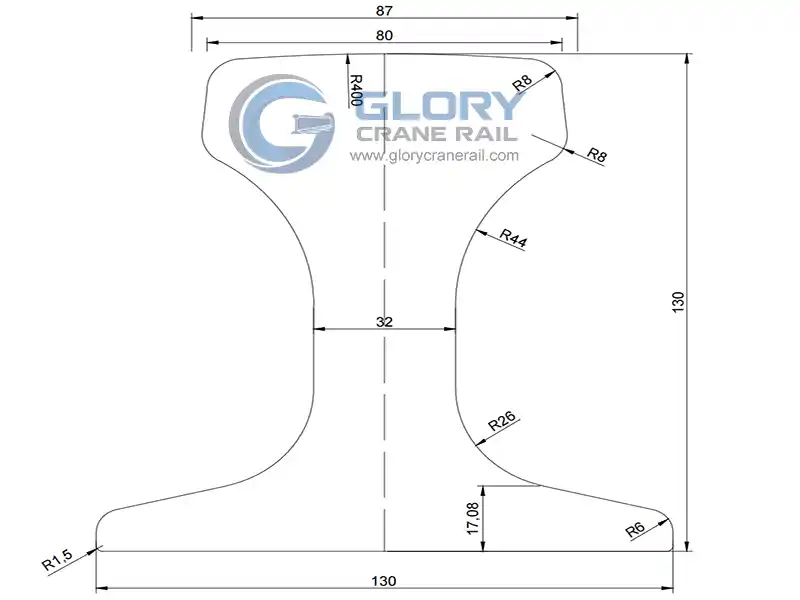
QU80:
Tread Width = 80 mm |
Height & Base Width = 130 mm (80 + 50)

QU100:
Tread Width = 100 mm |
Height & Base Width = 150 mm (100 + 50)
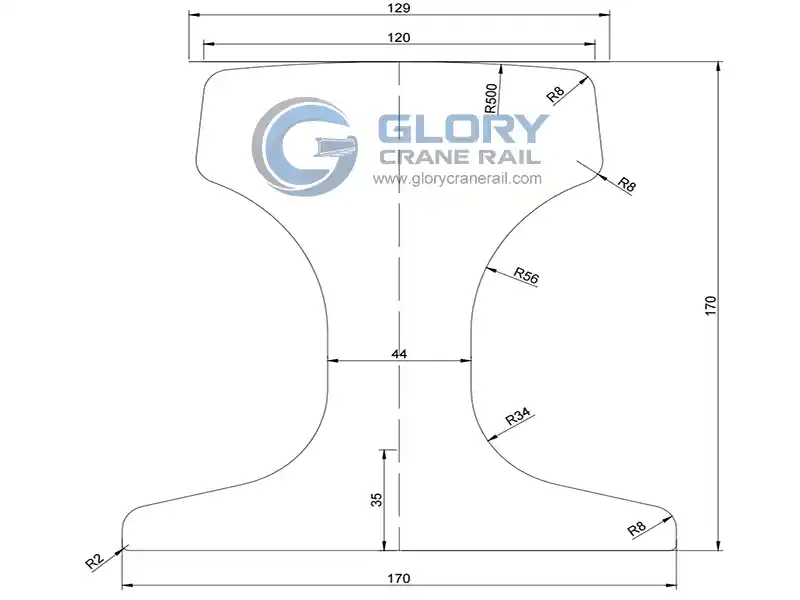
QU120:
Tread Width = 120 mm |
Height & Base Width = 170 mm (120 + 50)
(Note: According to Section 6.2 of YB/T 5055-2025, parameters such as local transition radii in die design—e.g., 76.5 mm and 108 mm—are internal reference values for steel rolling and are not considered delivery acceptance criteria [Data source: YB/T 5055-2025, Appendix A].)
Technical Support & Custom Rail Solutions
As a professional supplier of crane rails and track accessories that comply with international standards (China’s YB/T, Germany’s DIN 536, and the U.S.’s ASTM A759), Glory Rail’s engineering and technical team provides you with a full range of technical services, including CAD drawing analysis, custom-length cutting, and international logistics.
Get In Touch
After submitting the form, your dedicated account manager will contact you immediately to provide full-process technical support from selection to installation.
Your Expert in Crane Rail Solutions
To help us provide a faster and more accurate tailored solution, please consider including:
1. Rail Specifications: Rail section type, profile, or standard, and your required unit length.
2. Order Quantity: Total quantity of rails, matching fasteners, or related equipment needed.
3. Material & Grade: Specific steel material requirements or performance grades.
4. Technical Files: Any custom technical requirements, drawings (CAD/PDF), or project specifications.
Don’t have all the details? No worries! Just leave us a message with what you know, and our experts will guide you through the process.